the product we use
NexaNano Molecular Surface Treatment
Most exterior sealers work by laying a film across the top of a surface. The film is what does the protecting, so when it wears through, the protection goes with it. That is why traditional sealers need reapplying every year or two, and why they eventually crack, cloud, and peel.
NexaNano works differently. The particles are small enough to travel into the microscopic pores of concrete, wood, and stone, where they bond chemically with the material itself. There is no layer sitting on top to wear away. The surface keeps its original color and texture, but water and contaminants can no longer soak in.
It penetrates, not coats
The particles are a fraction of the width of a human hair, small enough to reach into pores that a conventional sealer simply bridges over.
It bonds at the molecular level
Once inside the material, the treatment chemically links to the substrate. The barrier becomes part of the surface rather than a layer resting on it.
It is water-based and non-toxic
No harsh solvents and no VOC fumes, so it is safe to apply around children, pets, garden beds, and established landscaping.
How It Compares to a Traditional Sealer
Traditional topical sealer
Sits on the surface as a separate film
Cracks, peels, and clouds as it ages
Typically needs reapplying every season or two
Often leaves a glossy or darkened finish
Water pools until it finds a gap in the film
NexaNano molecular treatment
Bonds inside the pores of the material
Nothing on top to crack, flake, or peel
One application, backed by a 10-year warranty
Invisible finish, no color or texture change
Water beads and runs off the surface
Diagrams are simplified to show the difference in how each product sits in the material. Actual results vary by surface type, age, and condition, which is why we assess every property before quoting.
What the Treatment Defends Against
Freeze and thaw cycles
This is the main cause of concrete failure in Iowa. Water soaks into the slab, freezes overnight, and expands. That expansion pushes the concrete apart from the inside, which shows up as surface flaking and cracking over a few winters. Keeping the water out removes the pressure that causes the damage.
Heavy rain and standing moisture
Porous surfaces act like a sponge during a long rain, and a saturated surface stays wet well after the weather clears. A treated surface sheds water instead, so it dries faster and spends far less time holding moisture against the material.
Mold, algae, and organic staining
Algae and mold need moisture and a porous surface to take hold, which is why shaded patios and north-facing walkways green up first. Removing the moisture they rely on makes the surface much harder to colonize and easier to keep clean.
UV exposure and fading
Long summer sun breaks down the surface of exposed materials, fading color and making wood and shingles brittle. The treatment helps the material hold its condition through repeated seasons of direct exposure.
Road salt and de-icing chemicals
Salt tracked onto a driveway dissolves in meltwater and carries straight into open pores, where it accelerates surface breakdown. Blocking the water path blocks the salt along with it.
Everyday grime and oil
Dirt, leaf tannins, and drips from a parked vehicle stain because they soak in before anyone gets to them. On a treated surface they tend to sit on top, which gives you a far better chance of cleaning them off completely.
How We Apply It
STEP 01
Assessment
We check the material, age, porosity, and current condition of each surface, then calculate how much solution it will take to saturate properly.
STEP 02
Preparation
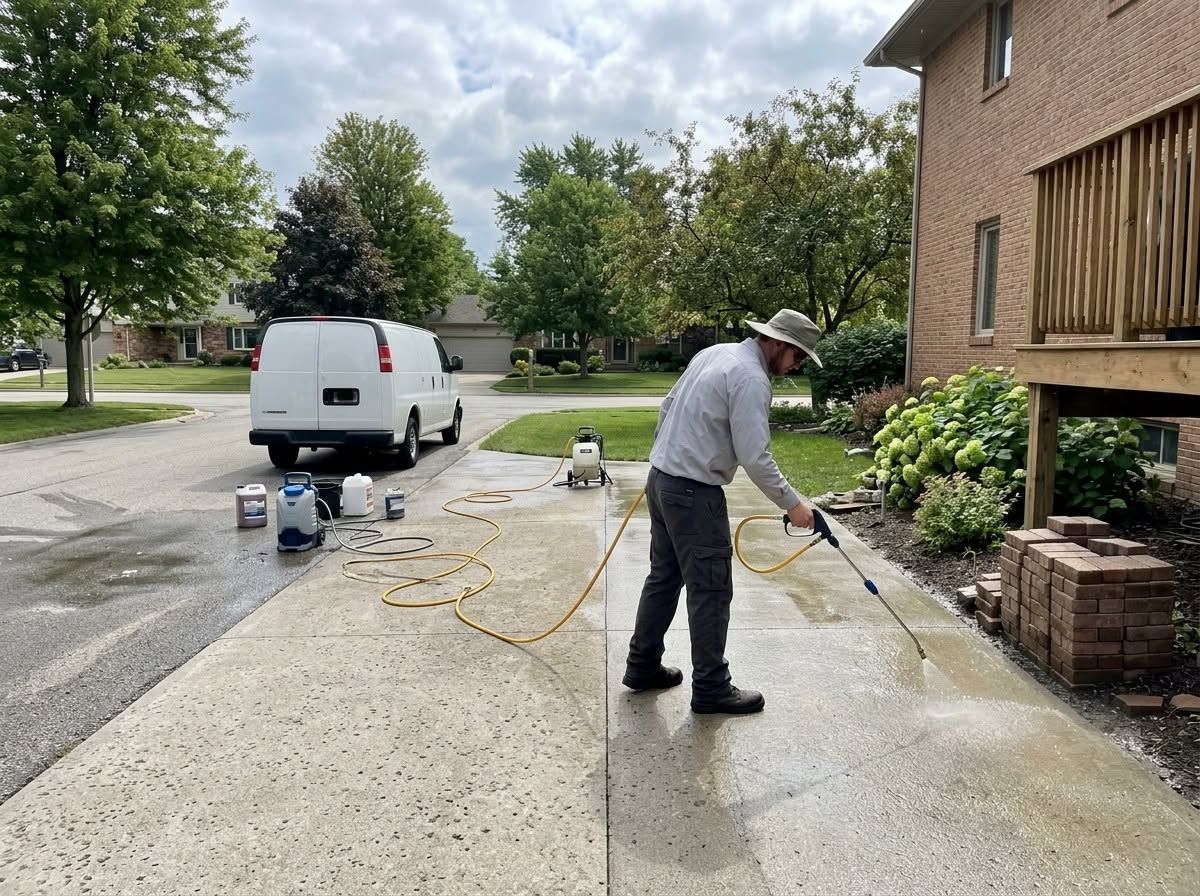
The treatment only bonds to clean material, so we power wash away dirt, algae, and buildup and let the surface dry fully before anything is applied.
STEP 03
Application
We apply the solution evenly across the whole surface so penetration is uniform, with no thin spots or missed edges that would leave a weak point.
STEP 04
Inspection
We walk the finished work with you, confirm full coverage, and explain what to expect from the surface going forward.